Choosing the right valve supplier is not simply about finding the lowest quotation. When a valve is installed in a high-pressure, high-temperature, chemical, oil and gas, or power-generation system, a poor sourcing decision can lead to leakage, downtime, premature replacement, or serious safety concerns.
And that is why choosing reliable manufacturers of forgings demands more attention to be paid to the manufacturing process, material quality, tests performed, documentation provided, delivery services, and technical support. When comparing forged valve suppliers, these factors can help you identify a manufacturer that meets your project requirements.
It does not matter if you are a purchasing specialist, an engineer, or an industrial buyer, you will find this handbook helpful for you.
What are Forged Valves and What are They Used for?
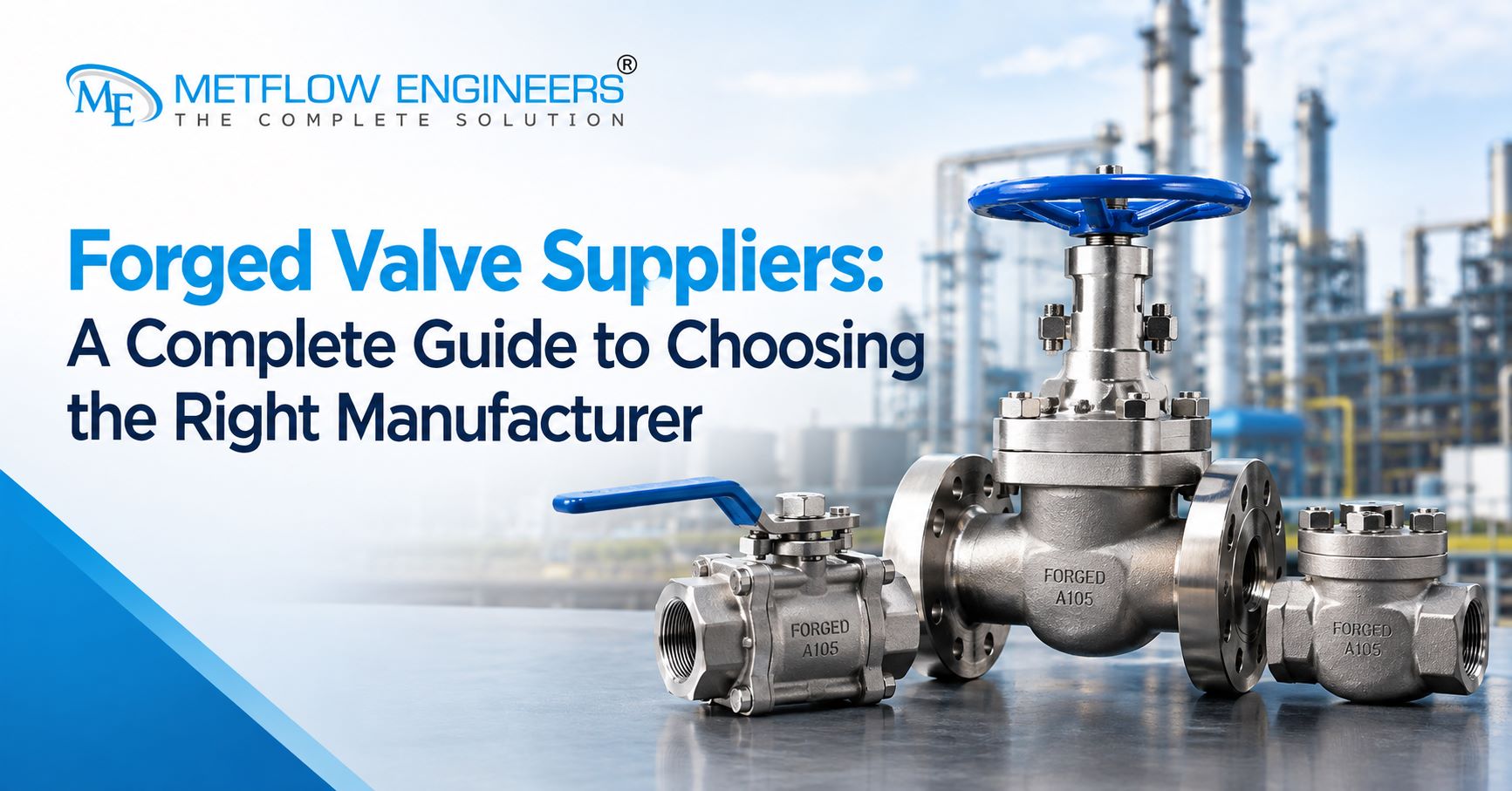
Forged valves are made from metal which is formed at high temperature and high pressure rather than being cast. This technique can offer very good mechanical characteristics in terms of strength and reliability for tough operations.
Forged valves are widely used for:
● Oil and gas systems
● Petrochemical facilities
● Chemical industry
● Power industry
● Steam systems
● Refineries
● High pressure piping systems
● Industrial gas applications
The most popular types of forged valves are:
● Forged gate valves
● Forged globe valves
● Forged check valves
● Forged ball valves
Forged construction becomes especially attractive for small nominal sizes and high-pressure operations because of its compactness and strength.
How to Choose Forged Valve Manufacturers
Not all of the companies which produce forged valves offer the same degree of engineering, manufacturing and documentation. Before requesting a quotation, evaluate forged valve suppliers against several important criteria.
1. Check Applicable Design Standards
The first question should be: Which standard is appropriate for your application?
For example, many forged steel valves are manufactured according to standards such as API 602, while testing may be performed according to API 598. Product specifications can also reference ASME standards for dimensions, pressure ratings, and end connections.
Do not assume that a valve is suitable simply because a supplier mentions an international standard.
Ask for confirmation of:
● Design standard
● Testing standard
● Pressure class
● Size range
● End connection standard
● Face-to-face dimensions
● Applicable temperature range
● Inspection requirements
A good supplier should be able to clearly match the valve specification to your purchase requirement.
2. Evaluate Material Quality and Traceability
Material selection is critical because the valve body, bonnet, stem, seats, and other components must withstand the actual service conditions.
Some of the common materials used are:
● ASTM A105 forged carbon steel
● F304/F304L stainless steel
● F316/F316L stainless steel
● F11 and F22 alloy steel
● LF2 low temperature steel
● Duplex & other special alloys
As per current material offerings from suppliers, the above-mentioned materials seem to be available for all forged valves based on process and application requirements.
But just specifying the material grade is not sufficient.
See if the supplier can supply material test certificates and/or heat traceability. That will help in verifying the material grade specified.
3. Look Beyond the Product Catalogue
Many suppliers have impressive product pages. That does not automatically mean they have strong manufacturing controls.
Before placing an order, investigate:
● Manufacturing facilities
● Quality-control procedures
● Inspection equipment
● Testing capabilities
● Experienced technical personnel
● Production capacity
● Previous industrial applications
● Export or project experience
● After-sales support
This is one area where buyers should distinguish between a manufacturer, a stockist, and a trading company.
A supplier may be perfectly suitable as a distributor for standard valves, while a critical engineered project may require direct manufacturer involvement.
What Should You Ask Forged Valve Suppliers Before Ordering?
A structured technical checklist can prevent expensive mistakes.
Ask your shortlisted supplier for the following:
● What design standard does the valve comply with?
● Which testing standard is followed?
● What materials are available?
● Can you provide material test certificates?
● What pressure classes and sizes are available?
● Which end connections can you supply?
● What inspection documentation is included?
● Can third-party inspection be arranged if required?
● What is the expected manufacturing and delivery time?
● Can the valve be customized to the project specification?
For example, suppliers currently serving the Ahmedabad industrial market commonly list API 602 design, API 598 testing, socket-weld, screwed and flanged connections, and pressure classes such as 800#, 1500# and 2500#.
The important point is not to copy a competitor's specification. It is to verify that your required specification is documented before purchase.
Why Testing and Inspection Matter
A forged valve may look perfect externally and still fail to perform correctly if its internal components, sealing surfaces, pressure integrity, or material properties are inadequate.
Reputable manufacturers therefore provide appropriate inspection and pressure testing.
Depending on the project, buyers may need:
● Hydrostatic body testing
● Seat testing
● Air testing
● Dimensional inspection
● Visual inspection
● Material verification
● Third-party inspection
● Documentation and test certificates
For example, published forged valve specifications from Indian manufacturers reference API 598 testing and provide defined body and seat test requirements.
For critical applications, make inspection requirements part of the purchase order rather than treating them as an afterthought.
How to Compare Forged Valve Suppliers on Price
Price matters, but the cheapest quotation is rarely the best comparison.
Instead, evaluate total cost of ownership.
The inexpensive valve may become more expensive because of its:
● Shorter life span
● Bad sealing capacity
● Non-availability of any documents
● Complicated spare parts availability
● Long replacement time
● Poor technical support
● Uneven quality
Industrial Buying Practical Case Study
Let's suppose that an engineering company based in Ahmedabad needs some forged gate valves for their process line where high pressure exists.
Supplier A is providing the lowest price but does not have any document.
Supplier B is giving a little bit higher price but with material certificate, pressure test report, API conformity, and definite delivery schedule.
Supplier C is providing customization facility but having long lead time.
For a critical process application, Supplier B may represent the better commercial decision even if its initial quotation is not the lowest.
This is the key distinction between buying a valve and selecting a valve supplier.
Why Local Supplier Collaboration Is Beneficial
For businesses based in and around the areas of Ahmedabad and the industrial zones in Gujarat, collaboration with a nearby supplier or manufacturer could be quite useful.
This could include:
● Better technical communication
● Better access to the factory
● Better clarity on specifications
● Better inspection coordination
● Reduced logistics time cycle
● Better follow-up post delivery
Ahmedabad has a significant number of manufacturers of industrial valves who manufacture forged gate, globe, and check valves for use in industries.
But the location is not a substitute for technical evaluation by the manufacturer.
Choosing a Forged Valve Supplier: Final Checklist
Before approving a supplier, make sure you can answer yes to most of these questions:
● Does the supplier understand your operating conditions?
● Are the valves manufactured to the required standards?
● Are material grades clearly documented?
● Is material traceability available?
● Are pressure and leakage tests documented?
● Will the supplier be able to supply you on time with the deliveries?
● Is it possible for them to provide inspections if necessary?
● Do they have experience in the industry?
● Can they provide technical data?
● Is the quoted price reasonable when total ownership cost is considered?
A supplier that checks these boxes is generally a stronger candidate than one competing only on price.
Why Metflow Engineers Should Be Evaluated on More Than Price
When evaluating Metflow Engineers or any other industrial valve supplier, buyers should use the same objective criteria: product specification, material quality, testing, documentation, delivery reliability, and technical support.
The strongest supplier relationship is not simply about getting a valve delivered. It is about having confidence that the valve is correctly specified, properly tested, and suitable for the operating environment.
If your project requires forged valves, use the checklist in this guide when discussing your requirements with Metflow Engineers. It can help your procurement and engineering teams ask better questions before finalizing a supplier.
A reliable valve supplier should make technical compliance easier to verify, not harder.
Frequently Asked Questions
What are forged valves used for?
The forgings are widely employed in various high-pressure applications and other demanding environments like oil & gas, petrochemicals, chemicals, power plants, and steam services.
How do I select forged valve manufacturers?
Select valve suppliers through comparing them according to their adherence to the standards, materials, testing, traceability, documentation, delivery capabilities, technical assistance, and overall price rather than just price.
Which standards should be considered in forging valves?
API 602 is usually related to forgings of gate, globe, and check valves, while API 598 is often cited when it comes to valve testing. Clarify the standard you need for your application.
Why is material traceability significant for forged valves?
Material traceability will help to assure that the parts have been made of the required material grades. This is related to quality assurance and document preparation.
Can forged valves be used in high-pressure applications?
Certainly. Forged valves are extensively used in high-pressure industrial services with manufacturers offering pressure classes including 800#, 1500#, and 2500# classes, according to design and application.
What questions should I ask my forged valve manufacturers?
Design, testing, material classification, pressure rating, ends configuration, inspection process, certification, delivery schedule, and possibilities for customizability.
Is the cheapest forged valve manufacturer always the best one?
Not necessarily. More expensive price of the valve at the beginning may provide more documentation, quality, testing, technical support, and service life.